
By Dr. Elizabeth Roberts, Psychologist
You've been told to validate feelings. Build relationships. Create a calm-down corner. Use restorative circles. Practice trauma-informed approaches.
And you are doing all of that.
But when a student melts down in the middle of math, refuses to start their work, or storms out of the room, those strategies feel impossible to access. You know what you're supposed to do in theory, but in the moment, your mind goes blank—or worse, you default to repeating the same ineffective response you swore you wouldn't use again.
Here's what most professional development gets wrong: it gives you the tools without teaching you how to use them.
Emotion coaching is different. It's not a new initiative to add to your plate. It's a framework that organizes what you already know into a step-by-step script you can actually use when the room is hot and your brain is trying to keep up.
And you are doing all of that.
But when a student melts down in the middle of math, refuses to start their work, or storms out of the room, those strategies feel impossible to access. You know what you're supposed to do in theory, but in the moment, your mind goes blank—or worse, you default to repeating the same ineffective response you swore you wouldn't use again.
Here's what most professional development gets wrong: it gives you the tools without teaching you how to use them.
Emotion coaching is different. It's not a new initiative to add to your plate. It's a framework that organizes what you already know into a step-by-step script you can actually use when the room is hot and your brain is trying to keep up.
What Is Emotion Coaching?
Emotion coaching is a research-backed approach (developed by psychologist John Gottman) that helps children and teens understand the emotions they experience, why they occur, and how to handle them.
The core principle is simple but powerful:
Your job isn't to control how students feel. Your job is to help them move through the feeling safely while holding clear boundaries about behavior.
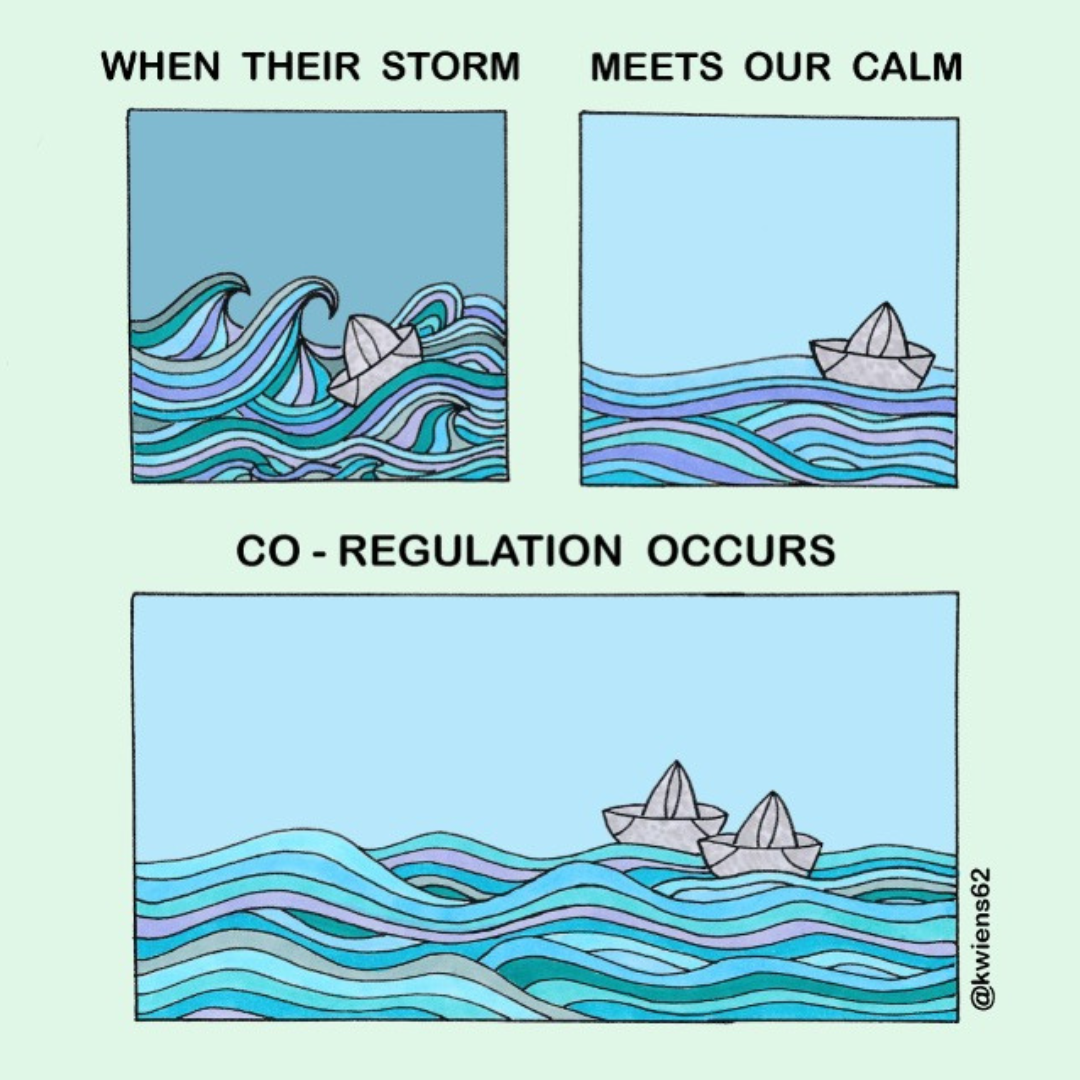
This is co-regulation in action.
The core principle is simple but powerful:
Your job isn't to control how students feel. Your job is to help them move through the feeling safely while holding clear boundaries about behavior.
This is co-regulation in action.
"All feelings are valid, but not all behaviors are acceptable."
Why Emotion Coaching Works: The Science of Co-Regulation
Think of a boat in a storm. When the waves are crashing (dysregulation), the boat can't steady itself. It needs calm water to settle.
Your calm is their calm water.
When a student is dysregulated—overwhelmed, angry, shutdown—their thinking brain is offline. They can't access logic, problem-solving, or empathy. They're in survival mode.
Emotion coaching works because it meets the nervous system where it is:
Most students live in the co-regulation zone. They need you to scaffold their emotional regulation until their brain develops the capacity to do it independently (which continues developing into their mid-20s).
Emotion coaching is the scaffolding.
Your calm is their calm water.
When a student is dysregulated—overwhelmed, angry, shutdown—their thinking brain is offline. They can't access logic, problem-solving, or empathy. They're in survival mode.
Emotion coaching works because it meets the nervous system where it is:
- Dysregulation (storm brain): Child is easily distressed, overwhelmed, reactive. Small window of tolerance. Impulse and action are fused.
- Co-regulation (with your support): Child can identify basic emotions and tolerate moderate intensity with adult scaffolding. Impulse and action slow down with your guidance.
- Self-regulation (calm brain): Child can identify and regulate emotions even at high intensity. Can reflect on choices and respond in alignment with their goals.
Most students live in the co-regulation zone. They need you to scaffold their emotional regulation until their brain develops the capacity to do it independently (which continues developing into their mid-20s).
Emotion coaching is the scaffolding.
The Teacher's Job vs. The Student's Job
One of the most important mindset shifts in emotion coaching is understanding what's yours to manage and what's theirs. This helpful framework comes from Dr. Becky Kennedy and it shows where a lot of teachers mistakenly pile too much on their shoulders.
Your Job: Validate feelings & set boundaries
Student's Job: Express emotions in reaction to those boundaries
NOT Your Job: Control their emotional expression
NOT the Student's Job: Control your boundaries
Here's the relief: Dysregulated outbursts and big emotional expressions do not mean you're failing.
Your job is to move through the feeling with them safely. Their job is to feel it. When you try to control their emotional expression, you're taking on a job that isn't yours—and you'll burn out trying.
Your Job: Validate feelings & set boundaries
Student's Job: Express emotions in reaction to those boundaries
NOT Your Job: Control their emotional expression
NOT the Student's Job: Control your boundaries
Here's the relief: Dysregulated outbursts and big emotional expressions do not mean you're failing.
Your job is to move through the feeling with them safely. Their job is to feel it. When you try to control their emotional expression, you're taking on a job that isn't yours—and you'll burn out trying.
The 5 Steps of Emotion Coaching
Emotion coaching follows a specific sequence. Each step builds regulation and prepares the student's nervous system for the next step.
Don't skip steps. Don't jump to problem-solving. The order matters.
Here's the framework:
Don't skip steps. Don't jump to problem-solving. The order matters.
Here's the framework:
STEP 1: Mindread, Label, Organize
Goal: Help the student identify what they're feeling.
Most students, especially those who are dysregulated, can't accurately name their internal state. You're doing the emotional identification for them until they can do it themselves.
What it sounds like:
Key phrases:
Then check in with curiosity (and give permission for the child to correct you):
Why this works: Naming the emotion activates the thinking brain and begins to down-regulate the stress response. You're organizing chaos into something recognizable.
Most students, especially those who are dysregulated, can't accurately name their internal state. You're doing the emotional identification for them until they can do it themselves.
What it sounds like:
- "I notice you're sitting with your head down. If I had to guess, I think you might be feeling overwhelmed. Does that make sense?"
- "I see you pushed your chair back. Sounds like you feel frustrated."
- "You look upset. Help me understand—are you angry? Embarrassed? Something else?"
Key phrases:
- "I notice..."
- "I see..."
- "If I had to guess, I think you might be feeling..."
- "Sounds like you feel..."
Then check in with curiosity (and give permission for the child to correct you):
- "Am I on the right track?"
- "What else are you feeling?"
- "Help me understand."
Why this works: Naming the emotion activates the thinking brain and begins to down-regulate the stress response. You're organizing chaos into something recognizable.
STEP 2: Empathize, Validate
Goal: Soothe the dysregulated nervous system and give permission to feel.
This is where most teachers want to start, but if you skip Step 1, your empathy won't land. The student doesn't know what they're feeling yet, so your validation feels empty or even intrusive.
Validation is NOT:
Validation IS:
What it sounds like:
Give permission for the emotion:
Pro tip: Match your tone to about 30-40% of their emotional intensity. If they're at a 10, you stay at a 3-4. You're modeling regulation, not mirroring their dysregulation.
Why this works: Empathic validation soothes the dysregulated brain. Connection from a trusted adult directly builds modulation skills. Your calm teaches them how to regulate.
This is where most teachers want to start, but if you skip Step 1, your empathy won't land. The student doesn't know what they're feeling yet, so your validation feels empty or even intrusive.
Validation is NOT:
- Agreeing with the behavior
- Excusing what happened
- Sharing your own story
Validation IS:
- Imagining you are the child and reflecting their own reactions, thoughts, and feelings
- Putting aside your judgment
- Remembering that all reactions make sense in some way
What it sounds like:
- "It makes sense that you feel this way."
- "This matters a lot to you."
- "You're allowed to feel frustrated."
- "It's normal, everyone feels this way sometimes."
- "I hear you. I want to be with you even when you're upset."
- "You didn't want that to happen."
- "That is a very tricky situation."
- "You must have been so surprised/shocked/upset."
Give permission for the emotion:
- "It's okay to want to be respected."
- "It's normal to want to be heard."
- "You're allowed to want things to be different."
- "You wanted to succeed."
- "You want what you want! That's not a bad thing."
Pro tip: Match your tone to about 30-40% of their emotional intensity. If they're at a 10, you stay at a 3-4. You're modeling regulation, not mirroring their dysregulation.
Why this works: Empathic validation soothes the dysregulated brain. Connection from a trusted adult directly builds modulation skills. Your calm teaches them how to regulate.
STEP 3: Set Limits
Goal: Separate the feeling (valid) from the behavior (not always acceptable).
This is where you hold the boundary.
The formula:
"It's okay to feel [emotion], but it's not okay to [behavior]."
What it sounds like:
One clear, matter-of-fact statement is all you need.
Don't over-explain. Don't negotiate. Don't defend the rule. State it once and move on.
Why this works: Limits provide safety. They tell the student, "I can handle your big feelings AND hold the structure." Predictability lowers threat for everyone in the room.
This is where you hold the boundary.
The formula:
"It's okay to feel [emotion], but it's not okay to [behavior]."
What it sounds like:
- "It's normal to feel embarrassed, but I need you to tell me the truth about what happened."
- "It's okay to feel angry, but it is not okay to punch, kick, yell, or insult."
- "It's okay to feel frustrated, but it isn't okay to hurt others or ignore what I'm asking."
One clear, matter-of-fact statement is all you need.
Don't over-explain. Don't negotiate. Don't defend the rule. State it once and move on.
Why this works: Limits provide safety. They tell the student, "I can handle your big feelings AND hold the structure." Predictability lowers threat for everyone in the room.
STEP 4: Problem Solve
Goal: Help the student build a coherent story and reflect on what happened.
Now that the nervous system is settling, you can move into meaning-making.
Co-author the story:
"A happened… which led to B (trigger)… then C (the emotion), and then D (your reaction)."
Why coherence matters:
Coherence → connection → safety → regulation
Incoherence → feeling alone, scared, disconnected → more dysregulation
Prompt reflection (don't tell them the answer):
Why this works: When students reflect on their own behavior, they own the solution. You're not imposing a fix, they're building insight.
Now that the nervous system is settling, you can move into meaning-making.
Co-author the story:
"A happened… which led to B (trigger)… then C (the emotion), and then D (your reaction)."
Why coherence matters:
Coherence → connection → safety → regulation
Incoherence → feeling alone, scared, disconnected → more dysregulation
Prompt reflection (don't tell them the answer):
- "Looking back now, what would you do differently?"
- "How could you handle it differently next time?"
- "What are two other ways you could solve this problem?"
- "How do you want to repair with Johnny?"
Why this works: When students reflect on their own behavior, they own the solution. You're not imposing a fix, they're building insight.
STEP 5: Coach
Goal: Connect behavior to values and goals.
This is where emotion coaching becomes transformative. Do not skip this step. This is the glue that makes it stick.
Ask the power question:
"Is this getting you what you want?"
Or frame it like this:
"Is this action moving you closer to who you want to become?"
What it sounds like:
Then practice alternatives:
Play It Out (The Fun Part): Best ROI
I guarantee you there is NOTHING a child loves more than watching an adult act silly, angry, or completely dysregulated. The unexpected role reversal is delightful and will lock in your lesson faster than any lecture.
If you have enough trust in the bank, let the child play teacher and you act 11/10 dysregulated. Have them coach you.
"I'm going to be SO MAD about this math problem. Ready? THIS IS IMPOSSIBLE! I QUIT!"
Watch them light up as they say, "Ms. Roberts, calm down. Take a breath. You can do this."
You just taught emotional regulation through play. And you'll probably only need to do it once—versus repeating yourself five more times.
Not everyone will vibe with this approach, and that's okay. But if you're willing to look a little silly for 60 seconds, this is one of the most effective teaching tools you'll ever use.
This is where emotion coaching becomes transformative. Do not skip this step. This is the glue that makes it stick.
Ask the power question:
"Is this getting you what you want?"
Or frame it like this:
"Is this action moving you closer to who you want to become?"
What it sounds like:
- "You want your friends to respect you, right? When you yell at them, does that get you respect—or does it push them away?"
- "You want to pass this class. Does refusing to work move you closer to that goal or further away?"
- "You want to feel in control. Does throwing your materials give you control—or does it make things harder?"
Then practice alternatives:
- Reflect on pros and cons of different reactions
- Select a solution to try next time
- Agree on a cue ("So next time, I'll remind you about our plan with this word/action/token")
- Play it out (role-play with humor if appropriate)
Play It Out (The Fun Part): Best ROI
I guarantee you there is NOTHING a child loves more than watching an adult act silly, angry, or completely dysregulated. The unexpected role reversal is delightful and will lock in your lesson faster than any lecture.
If you have enough trust in the bank, let the child play teacher and you act 11/10 dysregulated. Have them coach you.
"I'm going to be SO MAD about this math problem. Ready? THIS IS IMPOSSIBLE! I QUIT!"
Watch them light up as they say, "Ms. Roberts, calm down. Take a breath. You can do this."
You just taught emotional regulation through play. And you'll probably only need to do it once—versus repeating yourself five more times.
Not everyone will vibe with this approach, and that's okay. But if you're willing to look a little silly for 60 seconds, this is one of the most effective teaching tools you'll ever use.
Bonus: Dry Runs
Prepare students for tough moments before they happen. Use this when you notice repeated triggers.
Why this works: You're normalizing, labeling, and practicing regulation before the moment hits. This builds emotional muscle memory.
Prepare students for tough moments before they happen. Use this when you notice repeated triggers.
- "You know what I'm thinking? Playing Champ is usually hard. Everyone wants to play again today and you hate losing. You really want to win. How do you think you can handle it today?"
- "These math situational problems are LONG. It might feel overwhelming when you're halfway through and still have a lot left to do. What's your plan to stick with it?"
Why this works: You're normalizing, labeling, and practicing regulation before the moment hits. This builds emotional muscle memory.
When Emotion Coaching Backfires: The Timing Problem
Emotion coaching is incredibly powerful, but only when the conditions are right.
If you try to use this script during a full meltdown, in front of the whole class, or when the student is still escalating, it can make things worse.
Here's why: validation is a widening move. It invites reflection and connection. Without enough internal safety, validation doesn't calm, iit amplifies. This is called the intimacy barrier (a concept from Dr. Bruce Perry). When a child is defensive or self-protective, closeness can feel like pressure rather than support.
What doesn't work in the heat of the moment:
"Hey buddy, I can see you're really upset. Do you want to talk about what happened? Come here, let's sit down together and figure this out."
What does work:
"Sit here. Stack these books. We'll talk in five minutes."
Structure restores safety first. Empathy follows.
Emotion coaching works best when:
Read more: The Intimacy Barrier: When Empathy Backfires in the Classroom
If you try to use this script during a full meltdown, in front of the whole class, or when the student is still escalating, it can make things worse.
Here's why: validation is a widening move. It invites reflection and connection. Without enough internal safety, validation doesn't calm, iit amplifies. This is called the intimacy barrier (a concept from Dr. Bruce Perry). When a child is defensive or self-protective, closeness can feel like pressure rather than support.
What doesn't work in the heat of the moment:
"Hey buddy, I can see you're really upset. Do you want to talk about what happened? Come here, let's sit down together and figure this out."
What does work:
"Sit here. Stack these books. We'll talk in five minutes."
Structure restores safety first. Empathy follows.
Emotion coaching works best when:
- The system has settled
- The behavior has stopped
- The interaction can be contained (ideally away from peers)
Read more: The Intimacy Barrier: When Empathy Backfires in the Classroom
Common Questions About Emotion Coaching
"What if I don't have time for all 5 steps?"
Use the abbreviated version:
The full script is for off-to-the-side conversations, repair moments, and deeper coaching. The short version keeps the class moving.
"What if the student says 'I'm not feeling anything' or shuts down?"
That's information. Shutdown is a form of dysregulation.
Try: "You don't have to talk right now. I'm going to check back in 5 minutes. Take a break if you need one."
Then circle back with Step 1 when they're ready.
"What if they escalate when I try to validate?"
You're likely validating too early (intimacy barrier) or your tone is mismatched.
Pull back. Use structure instead: "Sit here. We'll talk in a minute."
Wait for the nervous system to settle, then try again.
"How often should I use emotion coaching?"
You don't need to emotion coach every single incident. In fact, with your toughest students, 2-3 times per week in intentional, off-to-the-side moments is enough.
Overuse dilutes the impact. Use it strategically for repair, teaching moments, and relationship-building.
Use the abbreviated version:
- Name the feeling: "You look frustrated."
- Validate briefly: "That makes sense."
- Set the limit: "But I need you to start the work."
- Redirect: "Take a breath. Try the first problem."
The full script is for off-to-the-side conversations, repair moments, and deeper coaching. The short version keeps the class moving.
"What if the student says 'I'm not feeling anything' or shuts down?"
That's information. Shutdown is a form of dysregulation.
Try: "You don't have to talk right now. I'm going to check back in 5 minutes. Take a break if you need one."
Then circle back with Step 1 when they're ready.
"What if they escalate when I try to validate?"
You're likely validating too early (intimacy barrier) or your tone is mismatched.
Pull back. Use structure instead: "Sit here. We'll talk in a minute."
Wait for the nervous system to settle, then try again.
"How often should I use emotion coaching?"
You don't need to emotion coach every single incident. In fact, with your toughest students, 2-3 times per week in intentional, off-to-the-side moments is enough.
Overuse dilutes the impact. Use it strategically for repair, teaching moments, and relationship-building.
Go Deeper: Learn the Full Framework
Emotion coaching is one piece of staying grounded when your classroom isn't.
If you want to learn:
Join my course: Staying Grounded When the Classroom Isn't →
It's designed for teachers who are tired of putting out fires and ready to build a classroom where both you and your students can breathe.
If you want to learn:
- How to read escalation structurally (not emotionally)
- When to use empathy vs. when to use structure
- How to end interactions cleanly without guilt or second-guessing
- How to stay regulated when students go rogue
Join my course: Staying Grounded When the Classroom Isn't →
It's designed for teachers who are tired of putting out fires and ready to build a classroom where both you and your students can breathe.
Subscribe to the Village Psychology newsletter for weekly teacher-friendly psychology tools that help students feel safe, seen, and supported.
GET IT HERE